Tuesday, July 22, 2014

#blogamonth goal setting


Goal #1: Build better relationships with my students. 
Last year my class had a reputation of being a difficult class, and I do not think I did a very good job of building relationships with these students. When I reflected on my teaching at the end of the year, I noticed there were lots of times when my main focus was to "just to get through the material." These are students that need personal connections, but due to my frustrations I failed to devote my time and energy building those connections. This year I have plans to improve on this essential facet of education. Here are some of my ideas to build these relationships:
1. Greet my students at the door everyday. Last year I was very focused on starting the class with a bellringer right away every day. Now that I have practiced that for a year, I think I will be able to emphasize welcoming students without losing class time.
2. Attend more extra-curricular activities. I know my students enjoy seeing their teachers at activities and will give me something to discuss when I welcome students. Last year it was difficult to attend fall sports because my wife coaches volleyball at a different school. Winter was tough because I coach wrestling and by the time spring rolled around I was just used to not going. This year it is a priority.


3. Be more interactive on social media. I have always tweeted class materials throughout the year but I was always a little worried about interacting with students. The few times I did interact with students, they were very excited about it and I know I can do a better job this year. I model being a good digital citizen on my twitter account, but if I don't interact with students they won't see that example. You can check out my twitter account @brandon_timm
Goal #2: Make my classroom accessible to anyone. 
Last year I attended Adolecent Literacy Project (ALP) and one of the presenters, Dr. Feldman talked about "deprivatizing education." I know the parents care about what their children are learning, but the most they get out of their children is that "school is fine." I want parents to be able to see exactly what their children are learning and how I am choosing to teach the material. I want other teachers in my district to see me implementing various engagement strategies so they have confidence using those strategies in their own class rooms. Here are my ideas for building a window into my classroom:

1. "Be a camera totin' teacher." I missed our last Breakfast Club on this topic, but I am very excited to to take more pictures in my classroom of what happens there. I would like to use these pictures to give students "twitter shout outs." I want to fill #ahsbio with examples of how awesome my students are.
2. I would also like to use my new website (http://mrtimmsbiology.weebly.com/) as a place to highlight these pictures as well. I think if parents can see their children learning, they will be able to ask better questions at home which, in turn, will hoe students learn as they explain concepts to their parents. 
3. I would like to record myself teaching and put in on the website regularly. First, ALP emphasized recording yourself as a way of providing feedback on what you are doing in the classroom. Also, this will be a great resource to any students who missed class. At Aurora, we have block scheduling which means when a student misses one day, they are significantly behind.

Goal #3: Provide opportunities for my students to experience the coolness of scientists
One of my biggest concerns is that I will cause my students to think they don't like science. It could be because they don't like me, the way I teach,  the topics we cover in sophomore biology, or the grade they received. I know lots of students who thought they hated a subject, but when they took it in college, they loved it. They didn't hate the subject, their high school teacher had let them down. Here are my ideas on how to remedy this problem:
1. Have my students participate in #scistuchat. As you can see, #scistuchat is a way for high school students to interact with superstar scientists who have dedicated their entire lives to the topic being discussed. For example, I am not particularly interested in sharks (probably because I live in Nebraska) @whysharksmatter who does a killer job promoting shark research and conservation. I would have been so jacked to make these connections when I was a high school student.

2. Some students do a lot better when they can meet people face to face. I have had the opportunity to skype with Erik Wilson, the education director at Wolf Haven International, a reserve that rescues wolves and wolf hybrids. My students were always extremely engaged during these Skypes and learned a ton. My goal this year is to get a scientist to skype or do a google hangout for my students every unit. I have made a Google Spreadsheet where you can add your name and contact information if you are a scientist and want to rock my students' worlds. Otherwise if you know of someone who might be interested' I would love to get in contact with them. My plan it to tweet all the units and see how many people respond and then tweet individual scientists at the start of the unit if no one has volunteered by then. 

I am very excited for the new school year and have set ambitious goals for myself. I am eager to get started and seeing the difference goal setting makes in my instruction!! If anyone has implemented any of these ideas, I would love to hear from you about your successes and difficulties! 

Wednesday, June 25, 2014

Thinglink Possibilities

An Intro to Thinglink
Thinglink is an app that allows you to choose a background picture and add text, pictures or video to areas of the picture to explain ideas. I first saw this app a few months ago when Mr. Phillips, a middle school math teacher here in Aurora tweeting examples of his students using it to explain math concepts. I thought it was pretty cool but didn't spend any time messing around with it. Then yesterday we had a Breakfast Club with Mr. Badura about app smashing. One of the ideas Mr. Badura was excited about was app die. You roll the die and whatever apps come up, you use those apps to do the assignment. In our example Word Clouds and Thinglink came up. Our assignment was to describe our summer and this is what I came up with. Summer

Using Thinglink in my Biology classroom
Last night, as I laying in bed watching lightening every 5 seconds, I finally had time to think about Thinglink in my classroom. The more I thought about it the more excited I got about its implications in helping students learn biology. I came up with 3 different uses for Thinglink.
#1 Taking notes
In biology we use a lot of diagrams to explain complicated processes. Thinglink would be a great way to annotate the diagram because it is more organizes than writing off to the side and you can see the diagram better than if you add a ton of text boxes to it. This would work for glycolysis, Kreb's cycle, electron transport chain, light dependent reactions, Calvin cycle, parts of a cell and the list goes on. Here is an example of how Thinglink could be used to take notes over the parts of a cell. Cell Structures Chromosome Information
#2 Exit Ticket
Thinglink would be a great way check that students understand the main learning onjective for the day. In our discussion of evolution, we discuss the 3 main types of adaptations according to  Nebraska State Standard 12.3.4a The last 10 minutes of class I could have this exit ticket: save a picture of an organism to your camera roll. Use Thinglink to identify and explain at least 1 morphological adaptation, 1 physiological adaptation and 1 behavioral adaptation. Here is an example that I made in 10 minutes about a snapping turtle. Snapping Turtle
#3 Assignment
The last way I thought of to use Thinglink is to use it as an assignment. During our genetics unit I have an assignment with a strand of RNA and a strand of DNA and the students have to show 3 ways they are different. They could use thing Thinglink to do that assignment quicker and better. The nice thing about this is even after they turn in the assignment, they can still use the assignment to study and learn the material.

These are the ways I plan on using Thinglink in my classroom next year! Do you have any different ways you use Thinglink, or examples of what you have done in the past? Or can you think of ways to make my ideas better? I would love to hear from you in the comments section!

Wednesday, June 4, 2014

Blog a Month "sharpening the saw"

#blogamonth
I stopped by the school this morning to attend a summer professional development opportunity that our school offers on a weekly basis. Mr. Badura, our technology integration coach, hosts/moderates an hour long session, called The Breakfast Club on various topics throughout the summer. He mentioned the #blogamonth challenge and I thought it would be a great way to get back into blogging. 

Summer Growth Plan #1
My first goal for this summer is to attend as many Breakfast Clubs as possible.  always has great information prepared and makes a concerted effort to make sure he doesn't just sit and talk. He allows us teachers to question and explain, which is great because then we learn what we want to learn rather than what he thinks is important. I have found that I am confident about most of the topics and some of the information is below my level. However, the main reason I want to attend is to spend time with Mr. Badura. He has such a passion for teaching that I always leave more excited about teahing than when I got there. His excitement is contagious and he is a real asset to our school. No matter what the topic is supposed to be, he finds a way to excite me about something new. 
@mrbadura

Summer Learning Goal #2
I don't want to gush too much so I'll limit myself to one more Mr. Badura shoutout. He is also offering individualized instruction where we can meet with him to work on whatever we need to. 
My goal is to create a website for myself so I can post information and resources there for my students, their parents and any science teachers that are interested. 

Summer Learning Goal #3
I teach 11 units throughout the semester. I would like to get 1 professional in each area to talk to my students. I always am concerned that my students will think they hate science because they don't like me, my teaching style, or their classmates. That's why I try to expose them to other scientists, who are way cooler than I am, so that their natural love of science can overcome their dislike for me. Here are my units and what I have set up so far.

Summer Learning Goal #4
Someone (who I won't mention by name) posted these 5 goals for the summer. 
I am planning on doing every other one starting with the first one. 

Summer Learning Goal #5
My final goal is to regularly check twitter and zite for articles that would fit in my units. I want to get my students reading about science in a setting they would be in after high school which are internet articles. 


Wednesday, October 9, 2013

Overcoming a Scientific Paper

A few weeks ago, I gave my students an assignment that made them panic. It was just 4 simple words, but the affect it had on the class was astonishing. I told that that they needed to...Write A Scientific Paper. Instantly, I was met with a chorus of complaints and whining before I could even describe the assignment. However, I persevered through the negativity to explain the project. It made me wonder why my students would be so terrified of writing a scientific paper.

Why Do I Put Myself Through This?
I have a few reasons that I think it is super important for high school students to know how to write a scientific paper. First, one of our school goals at Aurora is to improve reading and writing skills across the curriculum. This is a wonderful opportunity for them to practice both their reading and writing. They practice their reading because they have to find credible resources on-line and extract useful information from them. Then they have to summarize the articles in their own words to make it fit into their paper. They of course practice their writing by using proper grammar and style in their paper. Another reason I have students write a scientific paper is because writing formal paper is going to be important for them if they continue their education in college. Any major will require students to be well written, and if any of my students choose to pursue science, they will be expected to be able to write a 5-10 page scientific paper. I want to expose them to writing a scientific paper in high school before they get to college. It is better for them to struggle through it as a high school sophomore, where I can give them lots of advice and time and encouragement, then to never have them do it and be unprepared when they get to college. When I was in college, I had the privilege to lead a few labs, and during that time I got to know my professors fairly well. One the the biggest complaints science professors and Wayne State College had about incoming freshman was that they can't write scientific papers. This is frustrating for professors who feel like they are teaching junior high skills to college freshman, and it is frustrating for students who feel like professors have unattainable expectations for something they have never done before. Hopefully, because of this assignment, my students will be more prepared to face these challenges than the average high school student.

What Is The Assignment Like?
As I mentioned in a previous blog (Plant Project), we do a project where students try to get radish plants to grow better using household items. Then, I explain what things a good scientific paper should include.

  1. A descriptive title
  2. Abstract: summarize your entire paper into a paragraph.
  3. Object: 2-3 sentences (include hypothesis)
  4. Introduction: why is the experiment important, what do plants need to grow, what is in your independent variable that should help them grow or hurt their growth? (Have at least 2 internet sources)
  5. Methods and Materials: explain what you did so I could do your experiment at home.
  6. Results: have a graph showing your results with a paragraph explaining it.
  7. Conclusion: Was your hypothesis right or wrong? Why did you get the results you got? How could you make your experiment better for next time? What are the implications of your project? (Have at least two internet sources)
I also show the students a few scientific papers, so they can see how every single one follows these basic rules.

What Challenges Do Students Present?
There are a few challenges that students present that get on my nerves and make the project more difficult. The first one is "How long does it have to be." I do not know when or where they get it in their heads that all writing assignments are good if they are long enough and bad if they are too short. If you can get everything you need to include in a paragraph that is great. I wonder how many English teachers focus more on quantity rather than quality. (I guess it is easier to tell a student that they failed because they don't have 500 words than it is to explain why their writing is poor.) I probably had to tell my students 25 times that I don't care how long it is as long as they explain everything I ask them to explain well.

Another challenge that comes up is getting students to wrap their heads around a writing assignment that takes more than a 1/2 hour to complete. They are so used to scribbling together a crappy writing assignment the period before it is due (and passing because they have enough words) that they can't even contemplate spending several days and multiple hours making something they can be proud of.

I read an article about our culture (Losing Is Good For You) that talks about students thinking they can just show up, meet the minimum requirements and still get an A. They are so focused on "what is least I can do", that it never occurs to them to take the time to make something they are truly proud of.

Final Thoughts
I know that writing a scientific paper is challenging and difficult, but I strongly believe it is worth the time and effort. I am very excited to read a few of my students' papers because I know they will be wonderful. For I the time I spend focusing on the students who complain the loudest or are the laziest, there are just as many students working extremely hard to make a wonderful paper. I will post links to some of the best papers, so you can see all the hard work that went into them.

Grapefruit peels
Green Tea
Egg shells

Monday, September 23, 2013

Let them eat...Jello?

Cell Structure
One of the Nebraska State Standards is that students will know the form and function of the parts of the cell. I select the 13 that I think are the most important for an animal cell. After we have spent some time discussing the function of each organelle, I try to get them a hands on project to complete so they can remember the functions.
  • Nucleus
  • Nucleolus
  • Vacuoles/vesicles
  • Lysosomes
  • Cytoskeleton
  • Centriole
  • Ribosomes
  • Rough Endoplasmic Reticulum
  • Smooth Endoplasmic Reticulum
  • Golgi Apparatus
  • Mitochondria
  • Cell Membranes
  • Cytoplasm
 The final activity we do as a class is to make a model of a cell. I have seen lots of other classes make models of cells using things like paper, a cookie/cake with frosting or clay. However, the aspect of cells that I think students really miss out on is how fluid a cell really is. They see cells under a microscope and everything seems stuck in place and not moving, they see a diagram of a cell and everything is just sitting there and they make a cookie model and everything is just stuck there. However, cells are extremely fluid and everything in the cell is moving all the time. To help show this idea I have my students make a jello cell.(I show this video to get the point across as well).
Here is the outline of the project:

  1. Gallon bag = Cell membrane (the bag regulates what comes in and out of the "cell")
  2. Cytoplasm = lemon jello (fluid and allows for movement)
  3. Plum = Nucleus (The plum has a pit and skin like the nucleolus and nuclear membrane.)
  4. Peanut M&Ms = Vesicles (The peanut M&Ms store and transport the peanut)
  5. Lysosomes = Gummy bears (bears break things down)
  6. Cytoskeleton = Pull and peel licorice (long and stringy like cytoskeleton)
  7. Centriole = licorice nibs (a type of licorice because it is a type of cytoskeleton)
  8. Ribosomes = chocolate chips (they are small)
  9. Rough ER = fruit roll-up with chocolate chips (looks like a folded membrane sack)
  10. Smooth ER = fruit roll-up (same as Rough ER minus the ribosomes)
  11. Golgi Apparatus = Fruit by the foot (looks similar to fruit roll-up)
  12. Mitochondria = Snickers (gives lots of energy)
The students really enjoyed doing this activity because it was a fun way for them to review the functions of all of the organelles.

 To help this be more than just a screw around and have fun day, each group recorded themselves describing each part of the cycle. I was very proud of how well Block 3 did in their description. Block 3 Jello Cell
Here are the rest of the class videos:
Block 2a
Block 2b
Block 1a
Block 1b

This is also a wonderful way for students to study the functions of the organelles without having to sit and stare at a piece of paper. Once again, it is not trying to memorize the functions, but rather remembering how they described them.Of course, the best part of the activity is when the students get to eat them!!

Wednesday, September 11, 2013

Macromolecules: My Obsession with Paper Models

If a stranger were to walk into my room, the first thing they would notice is all the bright colored paper models hanging around my room. These models were made by my students and, I hope, help them learn some of the basics of macromolecules. The Nebraska state standards say that students should be able to identify carbohydrates, lipids, proteins and nucleic acids. I'm not sure what they mean by identify, but I assume a student should recognize one of these molecules if they see a picture of them, recognize them from a description, and recognize them from their functions. To help students master all three of these skills we have to do more than just give them notes to stare at. Students learn all sorts of different ways, so activities that stimulate more than one of the senses are always good. I do think it is important for students to be able to take good notes because, regardless of how well they learn a concept from notes, if they want to be successful taking college science classes they need to practice taking notes. However, just sitting and writing is ineffective for many high school students. Therefore, each class makes a paper model of each macromolecule.
Carbohydrates
The first complex molecule we discuss is carbohydrates. As they are designing these models, I overhear lots of interesting comments. Students will ask why are they all hexagons and another student will remind them that the monomer is glucose or a student will ask why theirs looks different than another class' model and a student will explain that one each one represents a different carbohydrate. This seems like a great way for students to reflect on what they learned about each macromolecule rather than just stare at a piece of paper. Also, when I review these concepts, I can just walk around the room and point to a model and ask them what it is, how they know that, and what its function is. Instead of them trying to recall what they memorized from their notes, they are recalling the steps they took while building the model and the conversations they had.
Starch
Cellulose

Glycogen
Protein
The next model we made was a protein model. We only talked about proteins in general, but we did discuss primary, secondary, and tertiary structure.We discussed that proteins are a chain of amino acids and then we built that primary structure. Then we discussed secondary structure and the students had to figure out how to give the chain alpha coils and beta sheets (lots of scotch tape!). Then they folded it into the 3-d shape of their choice. Now instead of memorizing what each of these structures are they can just think back to what was the first thing we did, the second thing, and the last thing. I also tweeted pictures of each of the structures so if they couldn't remember, they could just look back at that tweet. Studying tweets of things you did is better than studying a piece of paper.
Tertiary structure of a protein
Lipids
Saturated lipid
Straight chains
Polyunsaturated lipid
Chains with many bends


Monounsaturated lipid
Chains with one bend

Nucleic Acid
ATP/ADP
(with detachable Phosophate)
DNA


RNA
I believe anything that gets students moving, touching, doing and discussing will help them learn more than just sitting and writing. They also really enjoy getting to hang their models anywhere they want in my room and if making and hanging models makes science more enjoyable for sophomores, I am all for it. I posted pictures of these models on my twitter account as they were making them so feel free to check those out as well.
@brandon_timm or #ahsbio

Wednesday, August 28, 2013

Teaching with Inquiry (easy)

One of the skills I think it is vital for students to develop is a sense of inquiry. They need to wonder why, and then figure out a way to find out. Inquiry projects are virtually mandatory here in Nebraska with the state standards, and they absolutely should be! Literally (and when I say literally I don't mean figuratively http://www.cnn.com/2013/08/15/living/literally-definition) 5 pages of the standards are about doing inquiry and inquiry can be used to teach virtually any of the other standards. I really enjoy doing inquiry projects because you never know what the students are going to want to do or how they are going to test things. It's amazing how often my sophomores have better ideas than I do. However, I do think that high school sophomores benefit from some structure, so here are the outlines of some of the inquiry projects I do in my classroom. One of the negatives I hear from teachers is that it is too hard to find ways to incorporate inquiry into their classrooms so I wanted to give some super easy examples that I came up with to cover inquiry.

Potatoes
The first inquiry project that we did was about potatoes. We were studying the scientific method and I wanted my students to practice designing an experiment so I made up a scenario about potatoes sprouting. I said that potatoes on the counter sprout but the ones in the fridge do not. Each of my classes came up with a reason why they don't sprout in the fridge and designed an experiment to test it. Then I thought to myself, if these guys are going through all the work of designing an experiment, why not actually do it. 20 pounds of potatoes later, my classes have 3 potatoes inquiry projects currently underway.
This picture is from by third class who chose to test how the amount of moisture affects potato sprouts. The first set of potatoes is the control group with no water added, the second set is set on a piece of fabric that is kept moist and the last is a set of potatoes completely submerged in water. (An interesting side note about the second group is that the fabric is a pair of pants from a mannequin because that was the only fabric I had on hand...Lets just say the mannequin was much more realistic then I thought. My poor sophomores are scarred for life)
The class thought the one with the most water would grow the best but they are starting to disintegrate in the water. One of the potatoes on the counter is the first to start growing sprouts after only one week, but we will see if the group I'm backing (slightly moist) can make a comeback in the weeks to come. One of the nice things about this inquiry project is that it shows the students how easy it is to do an inquiry project. It doesn't have to be a huge ordeal, science can be quick, fun, and easy!


Chicken Liver
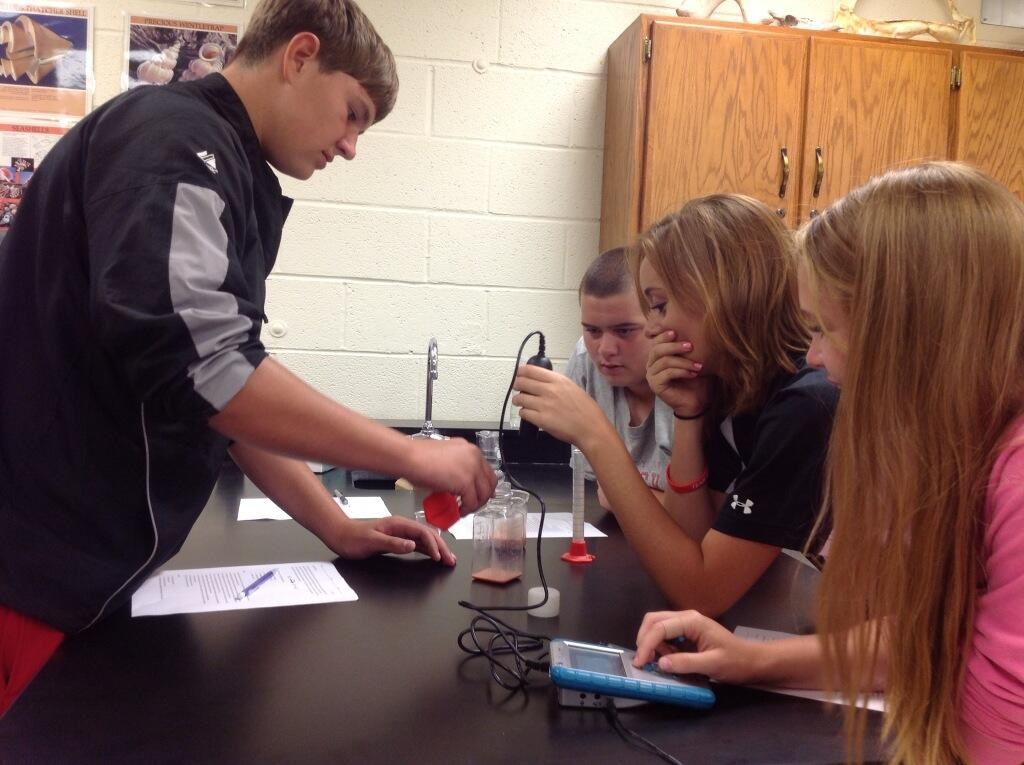
A lab activity we will be doing tomorrow also has a little bit of inquiry involved. We are studying proteins and one of the most important functions of proteins is to be an enzyme. My sophomores, however, seem to have no idea about enzymes even though they are so important. We are going to do a lab where catalase (obtained from chicken liver) is mixed with hydrogen peroxide to make oxygen and water. We use a LabQuest oxygen probe to measure how much oxygen is being made. This is a pretty straight forward lab, but I want my students to do more than follow directions. I want them to question why and use the scientific method to get answers. My challenge for them is to find a way to make it happen faster. Their ideas are usually add more liver, add more hydrogen peroxide or make it hotter. With a little prodding they can also come up with changing the pH.This is an easy way for me to change a "follow directions lab" into an inquiry project. (I'll add pictures from class after they do it tomorrow.)


Plant Growth
The largest and most complex inquiry project we do is our plant project. The objective is extremely easy: find a way to help plants grow better. First the students research what plants need to grow, especially what nutrients. Once they have that figured out, they research common household items that occasionally get thrown away that have those nutrients and might help the plants grow. Then they design an experiment to test that household item. My students have tested many things ranging from coffee (helps) to orange juice(nothing grows), from milk (no growth) to Gatorade (growth), from aspirin (no growth) to toothpaste (no growth). They plant the seeds (I have used Wisconsin fast plants in the past but am trying radishes this year) water it, and track growth for about a month. Then they share their findings by writing a scientific paper. (I'll blog about the challenges relating to that later.)